“The intersection of fiscal policy and legislative transparency is often where a nation’s social contract is either forged or fractured. And taxation without transparency is just capture. If the process lacks integrity, the policy lacks legitimacy.”
In response to public controversies around the authenticity/legitimacy of the new tax law in Nigeria.
CONTROVERSY SURROUNDING THE 2025 FINANCE ACTS
In an effort to bolster domestic revenue generation and enhance tax compliance, Nigeria recently overhauled its fiscal architecture through the enactment of four key pieces of legislation: the Nigeria Tax Act (2025), the Nigeria Tax Administration Act (2025), the National Revenue Service (Establishment) Act (2025), and the Joint Revenue Board (Establishment) Act (2025).
While these laws received Presidential Assent in June 2025, with a scheduled implementation date of January 1, 2026, the transition has been marred by a crisis regarding the legality of the versions currently in the official gazette.
The Nature of the Controversy:
The House of Representatives, led by the Minority Caucus, raised an alarm over significant “surreptitious alterations” discovered in various versions of the gazetted laws, most notably within the Nigeria Tax Administration Act, 2025. The Caucus alleges that the three versions currently in the public domain diverge substantially from the certified text originally transmitted by the National Assembly to the President for assent.
Key reported alterations made after the passage of the law include:
- Expansion of enforcement powers: granting tax authorities the power to arrest defaulting taxpayers via law enforcement agencies and sell seized assets without a prior court order.
- Barriers to appeal: the imposition of a mandatory 20% deposit of disputed tax sums as a condition for appealing a Tax Appeal Tribunal decision to the High Court.
- Currency mandates: compulsory computation of petroleum operations in US Dollars, contradicting the National Assembly’s version, which prescribed computation in the “currency of the transaction.”
Legislative Dissonance and Public Concern:
The situation is further complicated by a rare disconnect within the National Assembly. While the House of Representatives has confirmed these distortions, the Senate maintains that the gazetted laws remain consistent with the original legislative intent.
This lack of consensus, coupled with the unconstitutional nature of altering passed bills without legislative recourse, has triggered widespread disbelief. Stakeholders are now calling for a formal investigation and the prosecution of those responsible for the edits. Furthermore, the Nigerian public has advocated for a suspension of the January 2026 implementation until a unified, authentic version of the laws is restored to protect the rule of law and preserve both public and investor confidence.
Why we logged it
Buzz From The Streets is how we track what citizens are actually saying about governance and public services — sentiment by sentiment, in their own words. Each entry is read alongside the others to show where public trust is being built and where it is breaking down.
More from our work.

A-Goal Initiative Launches Project to Track Violence Against Women in Politics Ahead of 2027 Elections
On the International Day of Non-Violence, A-Goal Initiative has launched an early-warning project to track Violence Against Women in Politics in Nigeria, as the country builds momentum toward the 2027 General Elections.
Read press release →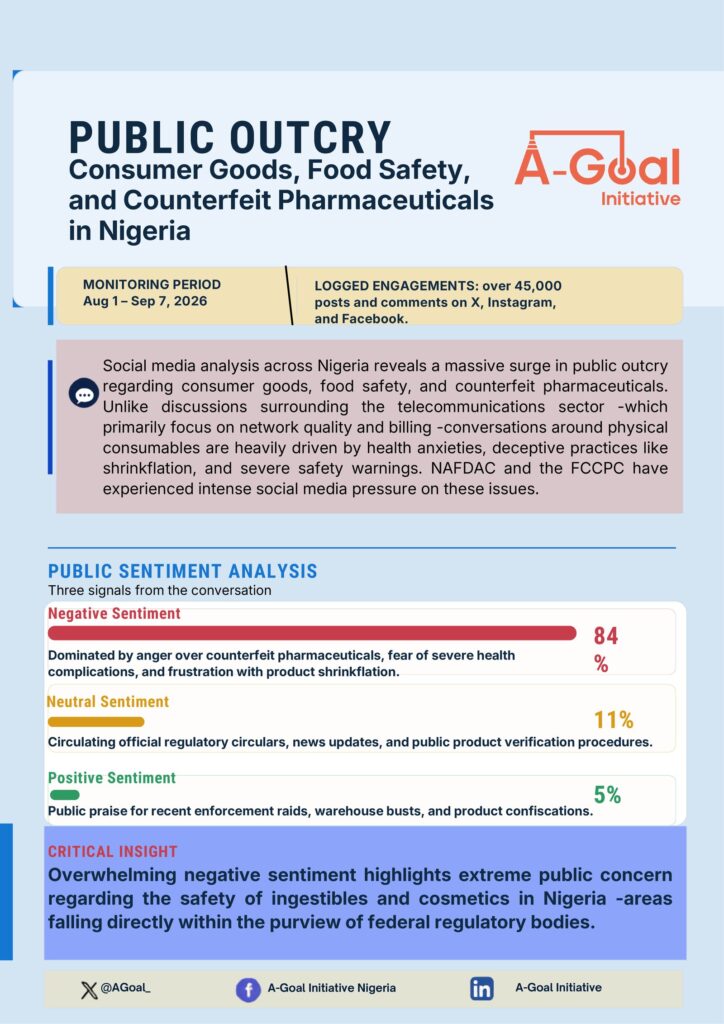
Public Outcry over Fake Consumer Goods, Food Safety and Counterfeit Pharmaceuticals in Nigeria – 12th Sept. 2026
Monitoring period 1 August to 7 September 2026. Over 45,000 posts and comments logged on X, Instagram and Facebook.